

Snake nutrition with long-term health in mind.
Shelf-stable snake food formulated by Dr. Ellen Dierenfeld, PhD, one of very few scientists with published, peer-reviewed research on snake nutrition.
Free Transition Guide · Free US shipping on orders $70+.
Worried your snake won't switch?
Snake nutrition with long-term health in mind.
Shelf-stable snake food formulated by Dr. Ellen Dierenfeld, PhD, one of very few scientists with published, peer-reviewed research on snake nutrition.
Free Transition Guide · Free US shipping on orders $70+.
Worried your snake won't switch?
What is it & how it works
Serious nutrition, simple feeding.
Feeding is three quick steps.
- 01
Soak
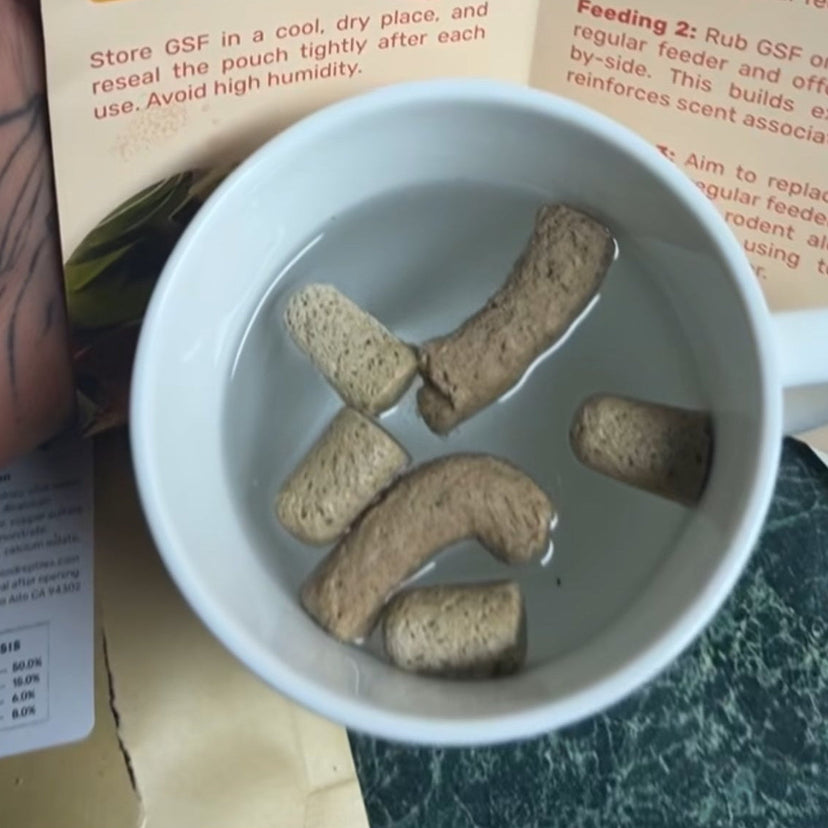
Drop Good Snake Food in hot water for 60 seconds or until it’s warm and soft.
- 02
Serve warm
When the texture is soft like a thawed rodent, warm the food, as needed, to near body temperature.
- 03
Offer
Feed with tongs or drop the food right in the enclosure.
Picky eater? Check out our quick tips in our Transition Guide, included in every order. A quick egg dip, rodent scenting, or broth soak can help. Most snakes adjust within 2–4 weeks (larger species up to 6+).

Your snake deserves a better feeding day.
“Feeder rodents are fine” only goes so far.
They’re the default, but they’re not always the healthiest option for your snake.
Bred for cost, not nutrition
Farm-raised feeders are optimized for cheap, fast production, not for a snake’s nutritional needs.
Too fatty, too lean on protein
Good Snake Food contains better protein and mineral content compared to fatty, farm-raised feeder mice.
Bacterial risk
Frozen rodents can carry pathogens, putting your snake at risk of exposure.
Adequate for feeding, not for lifelong health
A feeder mouse is not raised for optimal snake nourishment.
A conventional farm-raised feeder rodent vs. scientifically formulated snake food.

The Old Way
- Store frozen mice in your freezer
- Thaw and warm before every feeding
- Messy prep and cleanup
- Hard to travel with or stock up
- Inconsistent feeder sizing
- Fattier than your snake needs

Good Reptiles
- Store on a shelf, no freezer
- Soak and serve warm
- Clean: no thawing, no smell
- Easy to keep stocked
- Consistent, pre-portioned pieces
- Leaner whole prey nutrition
Nutrition formulated for your snake, not left to chance.
Whole prey nutrition developed with Dr. Ellen Dierenfeld, PhD, formulated leaner than feeder rodents and pre-portioned for consistency.
Scientifically formulated
Developed by Dr. Ellen Dierenfeld, PhD, comparative animal nutritionist.
Whole prey nutrition
Muscle, organ, and bone, fortified with vitamins and minerals.
Leaner than feeder rodents
Increased protein and mineral content compared to fatty, farm-raised feeder mice.
Consistent sizing
Pre-portioned pieces, every time. No feeder size guesswork.
Shelf-stable
No freezer required. Keep it on a shelf with your reptile supplies.
Free Transition Guide
A step-by-step guide to help adjust your snake, included with every order.
One of very few people who’s actually studied snake nutrition.
Good Reptiles was created to give snake keepers a cleaner, more practical feeding option, without treating nutrition like an afterthought.

Dr. Dierenfeld is an internationally recognized comparative animal nutritionist with 30+ years across zoos, conservation, and research. She has led wildlife nutrition departments at the Wildlife Conservation Society and the Saint Louis Zoo and now serves as Lead Specialist for Sustainable Feed Innovations at the World Wildlife Fund. She is one of very few scientists worldwide with published, peer-reviewed research on snake nutrition.
Dr. Ellen Dierenfeld, PhDComparative animal nutritionist · Good Reptiles formulation advisor
Whole prey snake food
Good Reptiles
Use code 20OFFGC! for 20% off.
Choose your size


Try us risk-free, full transition or your money back.

Worried your snake won't switch?
That's normal. Every order includes a free Transition Guide to help you introduce the food step by step. Most snakes adjust within 2–4 weeks (larger species up to 6+).
Start slow
Introduce Good Reptiles alongside your existing feeder rodent.
Follow the guide
Use the step-by-step transition process, including scenting and transition tips.
Watch the response
Different snakes adjust at different speeds. That’s completely normal.
Get support
Need more time? Reach out any time at hello@goodreptiles.com and we’ll help.
Snake keepers are switching for a reason.

4.33
80 reviews
Average rating across all reviews on goodreptiles.com.
Formulated by Dr. Ellen Dierenfeld, PhD, comparative animal nutritionist.
Keeper reels
Watch real keepers make the switch.
Filmed by the keepers
Reels play via Instagram · from keepers featured on goodreptiles.com.
Frequently asked questions
Yes! Good Reptiles snake food is made from lean muscle, organ meat, and bone, fortified with vitamins and minerals, with a small amount of plant material to represent the stomach contents of whole prey. It was developed by Dr. Ellen Dierenfeld, PhD, a comparative animal nutritionist, to match the nutrient profile of whole prey.
Yes. It’s cleaner, safer, nutritionally consistent, and far more convenient than feeding frozen mice or rats.
Yes. Our formula is designed to mimic the nutrients of whole prey, ensuring your snake gets the protein, fat, vitamins, and minerals it needs for growth, digestion, and sustained energy. The freeze-drying process locks in nutrition without the need for preservatives.
Our food is formulated with real ingredients such as beef muscle, organ meat (liver, heart, kidney, tripe), bone, mussel, egg, and chia to match the nutrient profile of whole prey. Additionally, it is fortified with a vitamin and mineral blend.
To prepare, place the portion in a small dish or cup and soak it in hot water for 30–60 seconds. Serve warm, or reheat briefly in hot water before offering, since many snakes respond to prey that is close to body temperature.
You can offer the food with feeding tongs or place it directly in the enclosure (drop-feeding). If your snake refuses, don’t be discouraged. Skipped meals are normal for most healthy adult snakes. Wait a few days and try again.
If your snake refuses, you can try these proven transition techniques: (1) Dip in egg: lightly coat the piece in quail or chicken egg; (2) Scent with rodent: rub the food against a thawed mouse, mouse fur, or rodent bedding; (3) Broth soak: briefly dip the piece in chicken or rodent broth (avoid over-soaking); (4) Timing: offer at different times of day, as many snakes prefer feeding at night; (5) Temperature: serve warmed to body temperature to trigger a feeding response; (6) Lighting: try dimming lights, especially for visual hunters that feel more secure in low light. Patience is key. Keep offering, even if your snake refuses the first few times. Over time, most snakes will learn to recognize the new food as safe and acceptable.
If uneaten, refrigerate the rehydrated portion for up to 1–2 days. Before re-feeding, re-soak briefly in hot water and serve warmed. If the portion remains uneaten after the second attempt, discard it.
Store the pieces in a cool, dry place, and reseal the pouch tightly after each use. Avoid high humidity, as freeze-dried pieces can soften or spoil.
Yes. Unlike frozen rodents, freeze-dried snake food is lightweight, shelf-stable, and easy to pack, making it ideal for travel or small living spaces.
Match it to the mouse you’d normally feed. Pinky is the pinky mouse equivalent for hatchlings and small snakes; Medium is the medium mouse equivalent for grown snakes.
Shipping is free within the continental US on orders of $70 and over, and most orders ship within 1 business day.
Try us risk-free, full transition or your money back. If it isn’t the right fit, reach out at hello@goodreptiles.com and we’ll make it right.
A PhD comparative animal nutritionist with 30+ years across the Wildlife Conservation Society, the Saint Louis Zoo, and now the World Wildlife Fund. She’s one of very few people globally with published, peer-reviewed research on snake nutrition.
We don’t make that claim. Good Reptiles is formulated with a PhD comparative animal nutritionist, a nutrition scientist, not a veterinary endorsement. As with any diet change, your own reptile vet is the best source of advice for your specific animal.

Ready to make feeding day easier?
Shelf-stable whole prey nutrition. No freezer, no thawing, no mess, full transition or your money back.
Try Risk-Free